So Long, Jewel Cases: The Slow, Agonizing Death of My CD Collection
It started, as most emotional crises do, with a Sunday afternoon and too much free time.
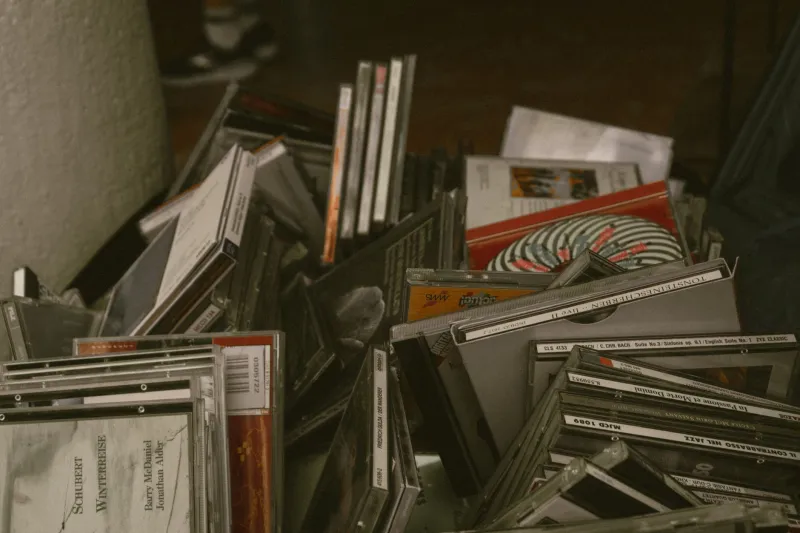
I was reorganizing the basement — which is a very generous way of saying I was avoiding something else — when I came face to face with them. Three milk crates, one tower rack that hasn't been dusted since the second Bush administration, and a shoebox full of loose discs I keep meaning to match with their cases. My CD collection. My life's work, if we're being dramatic about it. Which we are. We absolutely are.
The question I'd been dodging for approximately a decade finally showed up in person: What are you actually going to do with all of this?
We Didn't Buy CDs. We Built Identities.
Here's the thing Millennials and Gen Z will never quite understand: a CD collection wasn't just music storage. It was biography. It was argument. It was the physical, tangible, undeniable proof that you had been somewhere emotionally that other people hadn't.
You didn't just own Siamese Dream. You owned it on the day it came out. You rode your bike to Coconuts Music or Sam Goody or, if you were deeply cool, an actual independent record store, and you handed over $15.99 of babysitting money and you brought it home and you read every word of the liner notes while the album played. That's not nostalgia. That's archaeology.
The collection told your whole story in chronological order. The early embarrassments — the Ace of Base phase, the New Kids holdover from middle school that somehow survived into 1994 — sandwiched between the stuff you were actually proud of. The deep cuts. The import singles. The live bootlegs that cost $22 and sounded like they were recorded inside a washing machine.
Getting rid of them isn't decluttering. It's revisionist history.
The Justifications Are Getting Wilder
I have kept 47 CDs I will never play again using some of the most baroque logic ever assembled by a functional adult.
This one is scratched, so I can't donate it — someone would be disappointed. (Nobody is waiting on a donated copy of the Counting Crows' Recovering the Satellites.)
This one is a first pressing, so it might be worth something. (Checked. It is not.)
I might get a CD player for the car again someday. (I drive a 2019 Honda CR-V with a USB port and Bluetooth. I will not.)
My kid might want to listen to this. (My kid has Spotify Premium, AirPods, and zero interest in anything that requires a physical component.)
I can't donate the whole set — they belong together. (Reader, it is a NOW That's What I Call Music! compilation. They do not belong together. They never did.)
The mental gymnastics are impressive. Olympic-level, really. We could medal in the event of Keeping Things We Don't Need By Inventing Elaborate Futures Where We Need Them.
The Ones That Are Actually Staying
Look. I'm not a monster. There's a short list — a genuinely short list — of discs that are not going anywhere.
The copy of Nevermind with the water damage on the case from when I left it in my car in August 1992. The Pulp Fiction soundtrack, because it's the Pulp Fiction soundtrack. A handful of albums that are genuinely out of print and not available on any streaming service, because apparently the digital revolution did not consider it a priority to preserve every B-side from a regional post-punk band from Cleveland.
Those stay. Everything else is negotiable, even if the negotiation is taking three to five years longer than it should.
Where Do They Even Go?
This is the part nobody warned us about. The logistics of letting go.
Thrift stores will take them, mostly. Half Price Books will offer you approximately $0.25 per disc, which is insulting enough to actually be funny. Facebook Marketplace has a market for bulk lots, if you're willing to spend forty minutes photographing them and then another two weeks waiting for someone to cancel the pickup. There are online communities dedicated to trading and selling used CDs, which is either heartwarming or a sign that the internet has an answer for literally everything.
And then there's the truly unhinged option: keeping the digital files and tossing the physical media. Which, technically, is what we've already done — we ripped most of this stuff to iTunes in 2006 and haven't touched the actual discs since. The CDs are basically backup copies of music we already have in four other formats. We know this. We know this and we keep them anyway.
What We're Really Saying When We Can't Let Go
Here's the honest version, stripped of the funny justifications.
Getting rid of the CDs means admitting that a specific chapter is closed. Not just the music, but the version of yourself who bought the music. The person who spent three hours in a record store on a Saturday not because they were looking for anything in particular, but because being in a record store was a thing you did. The person for whom $15.99 was a real decision, and making it felt like a commitment.
Streaming is convenient and wonderful and I use it every day. But it requires nothing from you. It costs you no deliberation. You don't have to want something enough to go get it. You just tap a screen and it appears, and then you tap a different screen because the algorithm already has a suggestion, and three hours later you've heard a lot of music and none of it stuck.
The CDs stuck. That's the whole problem. They stuck so hard that I am standing in my basement in my forties, holding a cracked jewel case, having actual feelings about a disc I haven't played since the Clinton administration.
Fine. Some of Them Can Go.
I'm keeping a crate. One crate, which is already a negotiation I'm losing with myself. But the rest of them — the duplicates, the regrets, the inexplicable purchases, the soundtrack to a movie I didn't even like — those can go find a new home.
Somebody at a thrift store is going to find a copy of August and Everything After for $1.99 and feel like they discovered buried treasure. That's not nothing. That's actually kind of beautiful.
And if I occasionally feel the ghost of a jewel case in my hands when I open Spotify? Well. That's just what it costs to have been young in a very specific decade. We were there. We have the scratched plastic to prove it.
Most of it, anyway.