Your Pocket Is Lying to You and Your Brain Keeps Falling For It
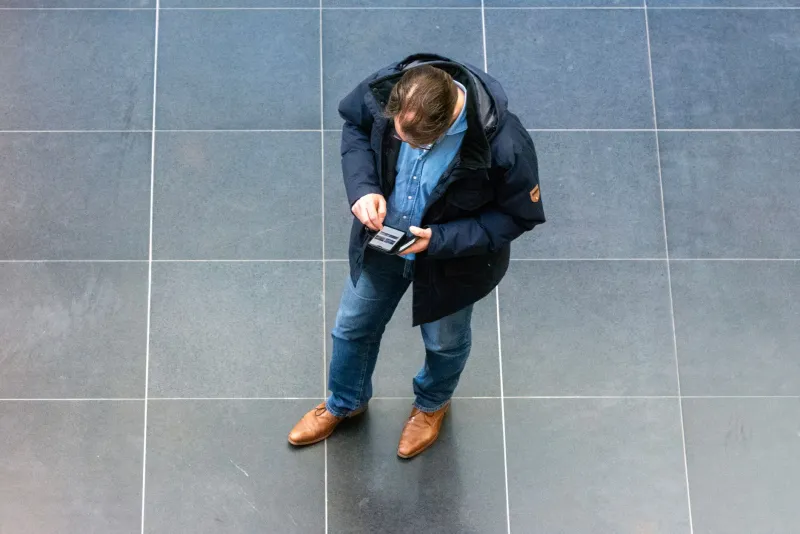
It happens at the grocery store. It happens during your kid's school play. It happens, mortifyingly, in the middle of a conversation you are actively having with another human being. Your thigh buzzes. You reach for your phone with the practiced speed of someone who has been conditioned over three decades to respond immediately to electronic summons. You pull it out.
Nothing. No notification. No missed call. No text from anyone. Just you, standing in the cereal aisle, holding your phone like an idiot.
Welcome to phantom vibration syndrome, and congratulations — Gen X basically built the psychological infrastructure for it.
The Beeper Did This to Us
Let's go back, because context matters here. Before smartphones turned everyone into a twitchy notification-checker, before even the brick-sized cell phones of the mid-nineties, there was the beeper. The pager. That small, clip-on rectangle of pure social anxiety that told you someone needed you right now and gave you absolutely no information about why.
If you wore a beeper in the late eighties or early nineties — and a lot of Gen X did, either for work, for social reasons, or because you were trying to look important — you developed a specific kind of hypervigilance. Missing a page had consequences. Real ones. Your boss couldn't reach you. Your friends assumed you were dead or flaking. Your college roommate who had exactly one quarter left for the pay phone at the student union was going to be furious.
So your brain learned to listen. Constantly. Not just to the device, but to the possibility of the device. You started checking it before it went off. You started feeling it go off when it hadn't. Your nervous system essentially decided that the cost of missing a signal was high enough to justify generating false positives on a rolling basis.
That, right there, is the factory setting we've been running on ever since.
Early Cell Phones Made Everything Worse
Then came the actual cell phones, and if the beeper primed the pump, the Nokia era absolutely blew the pipe open. Suddenly the stakes were even higher, because now people could actually talk to you. They expected you to answer. Voicemail was a thing, yes, but letting a call go to voicemail in 1997 carried a faint whiff of social irresponsibility. Why didn't you pick up? Where were you? Is everything okay?
The early cell phone was also physically unreliable in ways that trained us to second-guess ourselves constantly. Calls dropped. Batteries died without warning. The vibration motor in those early handsets was about as subtle as a jackhammer strapped to your hip, which meant you actually did sometimes miss it, especially in loud environments. So your brain, ever the diligent little threat-assessment machine, responded by amplifying its sensitivity. Better to feel ten phantom buzzes than to miss one real one.
Millennials got smartphones in high school. Gen Z essentially emerged from the womb clutching an iPhone. But Gen X came to this technology as adults, with already-formed anxiety responses and a learned understanding that missing a communication had actual social and professional fallout. We didn't adapt to the technology. We fused with it, and the fusion was a little messy.
What the Science Says (And Why We Already Knew)
Researchers started studying phantom vibration syndrome in earnest around 2012, and the findings were, if you are Gen X, deeply unsurprising. The phenomenon is tied to a concept called hypervigilance — a state of heightened sensory alertness your brain adopts when it's been trained to expect important incoming signals. Your nervous system essentially keeps a low-level background process running at all times, scanning for the stimulus it has been conditioned to prioritize.
The result is that your brain starts pattern-matching ambient sensations — the brush of fabric against your leg, a muscle twitch, a slight pressure shift — and misidentifying them as the thing it's been told to watch for. It's not a malfunction. It's your brain doing exactly what you trained it to do, just a little too enthusiastically.
Studies have found that people who rely more heavily on their phones for social and professional connection report higher rates of phantom vibrations. Which is a polite academic way of saying: people who grew up being genuinely penalized for missing a call feel fake buzzes more often. Gen X, please stand up.
The Part Where We Can't Actually Fix It
Here's the genuinely annoying part: knowing about phantom vibration syndrome does essentially nothing to stop it. You can read every neuroscience explainer on the internet. You can acknowledge, out loud, to another person, that your phone has not vibrated and you are experiencing a cognitive glitch rooted in decades of conditioned anxiety. And then, twenty minutes later, you will reach for your pocket again.
Some people try switching their phone to airplane mode for stretches of time. Some people put the phone in a bag instead of a pocket, removing the tactile proximity entirely. Some people — and this is a very Gen X solution — just decide to accept it as one of the many low-grade annoyances of being alive in a body that was optimized for a slightly different era and move on with their day.
The irony is that we are now, by most measures, the generation most capable of actually ignoring our phones when we choose to. We remember what it was like before them. We have the muscle memory of boredom and disconnection. We can, when sufficiently motivated, put the thing down and walk away.
Our nervous systems just haven't gotten the memo.
Still Reaching, After All These Years
There's something almost poignant about it, if you're in a generous mood. Every phantom buzz is a little neurological echo of a time when connection required effort, when being reachable was a genuine logistical challenge, and when missing a call from the right person at the right moment could actually change the course of your day. We built our anxiety around that reality because that reality was real.
Now the calls come easy. The texts are instant. The notifications are endless and mostly useless. And yet the hand still moves toward the pocket. The brain still fires the old signal. The body still responds like it's 1994 and someone important might be trying to reach you from a pay phone outside a Denny's.
It's not a disorder. It's not a dysfunction. It's just Gen X, still showing up for a call that already went to voicemail about thirty years ago.
Check your phone if you need to. We'll wait.