The Voice of the House: How the Answering Machine Became Gen X's First Audition
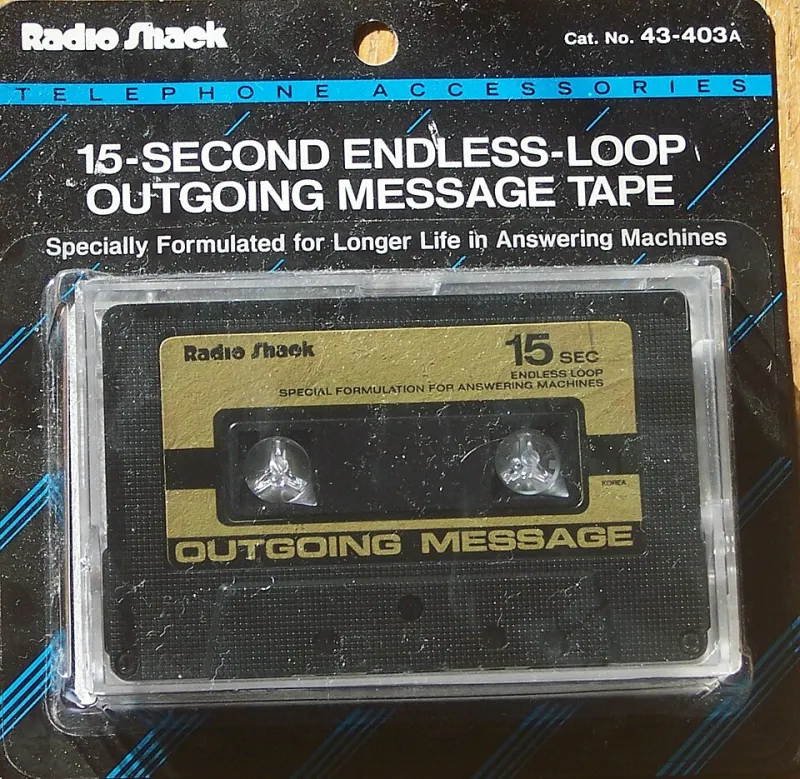
Photo: Wasted Time R, Public domain, via Wikimedia Commons
There was a room in every Gen X house where the whole family performed. Not the living room. The kitchen counter, next to the phone, where a black plastic box with a blinking red light held a cassette the size of a Triscuit and, on it, the official voice of the household.
We did not call it content. We called it the machine. But make no mistake: it was our first broadcast, our first audition, our first taste of the terrible creative pressure that comes with knowing other people will hear you later.
The Machine on the Counter
The setup was always the same. A cordless or — for the truly fancy — a corded phone with a curly cord long enough to reach the pantry. A base unit with a keypad and a small window counting messages. A tape that could hold maybe thirty minutes and made a satisfying mechanical clack when you rewound it, usually while standing right there, usually too close to the microphone.
Recording the greeting involved holding a button, watching a red light, and speaking with a confidence you did not have. Two takes, if you were lucky. One if the machine was feeling ornery.
The Politics of Who Records It
This was the real drama. The outgoing message was a tiny elected office, and the campaign was brutal.
- Mom usually opened, because Mom answered the phone most, and because her voice said we are a normal family with a casserole in the oven.
- Dad did the low, radio-announcer version, which he considered professional and everyone else considered mortifying.
- The eldest kid lobbied hardest and was most often denied, on the grounds of sounding like a chipmunk.
- The youngest got one shot as a toddler, said something unintelligible, and that tape played for the next six years because Mom would not let it go.
The compromise version — Hi, you've reached the Walshes, we can't come to the phone, please leave a message — was delivered by whoever could say it without cracking up. That was the whole bar. Nobody cleared it.
The Cleverness Arms Race
Somewhere in the mid-80s, a neighbor figured out that the outgoing message was a stage, and the neighborhood never recovered.
Suddenly you were hearing jokes. You were hearing fake hold music. You were hearing a kid do a full KISS-FM deejay impression — you're on the air with the Hendersons — complete with sound effects made by mouth. There was a house on our street whose greeting changed weekly and became, in effect, appointment listening for a nine-year-old with nothing else going on.
We envied those houses. We also judged them. Being funny on a machine felt like showing off, and we were raised by people who thought showing off was a gateway drug.
Family Lore in Fourteen Seconds
What we didn't know then was that we were making archives. Those greetings captured voices at specific ages — the brother whose voice dropped between Thanksgiving and Christmas, the grandmother visiting for a week who got a cameo, the dog barking at exactly the wrong moment and staying in the final cut forever.
Most of those tapes are gone now. Thrown out with the machine, or recorded over by a message from a plumber in 1997. If you have one, you have something closer to a time machine than anything Silicon Valley has ever sold you.
The Blinking Red Light
The light was the other character in this story. It blinked to tell you someone had called and left a message, and it blinked with the moral authority of a nun with a hall pass.
You'd come home from school, see the light, and press play with your whole body braced. Sometimes it was your mom. Sometimes it was a classmate who wanted homework. Sometimes it was the orthodontist reminding you about a Tuesday appointment you had absolutely no intention of attending.
The machine also created the phenomenon of the message you were not supposed to hear — a parent hitting play, hearing a voice, hitting stop with a speed that suggested someone had been practicing. We all learned to read that room.
Press 1 to Feel Guilty
Here's the part that stings in 2026. We now carry a machine in our pockets, and it is somehow worse at this job.
Voicemail arrives as a notification you swipe away. There's a transcription you skim. There's a little alert that says you have eleven unheard messages, and you feel a small hot wave of shame because eleven is not a number, it is a personality flaw.
And when you do call, you get a synthetic voice reciting options. Press 1 to leave a message. Press 2 for the directory. Press 3 to wonder what your life has become.
No human comedy. No dog barking. No kid doing a deejay voice, badly, on purpose.
The Message We Left Ourselves
We roll our eyes at the memory of the family greeting — the awkward pauses, the dad voice, the neighbor who thought he was Johnny Carson. But notice: we all still remember the words. Twenty-five, thirty years on, and some of us can do our childhood greeting verbatim, in the voice of whoever recorded it, complete with the sigh at the end.
That's not nostalgia. That's evidence of something that actually mattered.
So here's to the beep. It never asked for a password. It never tried to upsell us. It just waited, patiently, for someone to say who we were — and then let us try again.