Proudly Unreachable: The Quiet Rebellion of Choosing to Be Bored

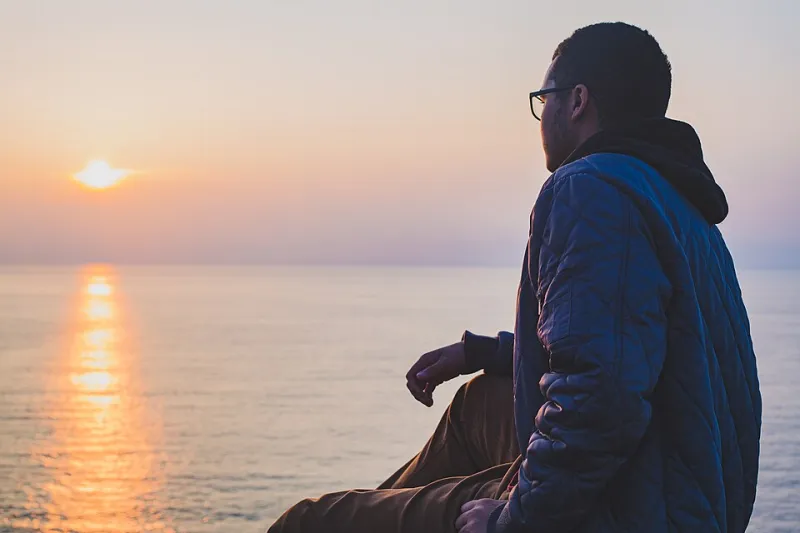
Photo by Photo by Christian Harb on Unsplash on Unsplash
I want to tell you about my Sunday morning. I woke up. I made coffee — not with a smart machine that grinds and brews on a schedule, but with a stovetop percolator that requires actual attention. I sat in a chair. I read about forty pages of a paperback novel that I got at a used bookstore for $2.50. I did not check my phone for the first two hours of the day. I did not listen to a podcast. I did not optimize my morning routine or practice gratitude journaling or consume content of any kind.
By most contemporary metrics, I wasted that morning spectacularly.
I have never felt better about two hours in my life.
This is not a wellness column. I'm not going to tell you to do a digital detox or buy a gratitude journal or download an app — and yes, the irony of an app that helps you be less online is something we're all just going to have to sit with. This is something else. This is a defense of a certain kind of Gen X person who has quietly, deliberately, and without much fanfare decided to step back from the velocity of constant digital connectivity — and is now being looked at like they've joined a cult.
The Flip Phone People Are Onto Something
Let's talk about the flip phone people.
You know at least one. Maybe you are one. They exist in your life as a kind of living provocation — at a dinner table, their phone is small and plasticky and cannot, under any circumstances, run Instagram. They do not receive group texts with any reliability. Getting in touch with them requires either calling (calling!) or accepting that the message will arrive whenever it arrives, which could be Tuesday.
And here's what's remarkable: they seem fine. Possibly better than fine. They have a certain quality of presence that is genuinely difficult to name but easy to feel — the sense that they are actually, physically here, in the room, in the conversation, rather than 30% here and 70% somewhere else on the internet.
The rest of us have quietly normalized that 70/30 split. We have accepted as baseline a state of perpetual partial attention, and we've dressed it up in language like "staying connected" and "keeping up" as though the alternative is falling off the grid entirely and moving to a cabin in Montana. The flip phone people have correctly identified that the real choice is not "smartphone or Montana." The real choice is "smartphone or something slightly less demanding than a smartphone," and they made it, and we're all a little jealous.
Gen X Was Built for This
Here's the part where I make the generational argument, because this is GenX Daily and that's what we do.
We grew up with boredom. Not the kind that you solve in 45 seconds by opening a different app, but the long, slow, unresolved boredom of a Saturday afternoon in 1986 with three channels on TV, your best friend not home, and two hours until dinner. That boredom was not a problem to be fixed. It was a condition to be inhabited. And what happened inside that condition — the daydreaming, the wandering, the picking up a book or a sketchpad or a baseball purely because there was nothing else — was not wasted time. It was, in retrospect, the most formative time we had.
We are, as a generation, uniquely qualified to be offline. We know what it feels like. We did it for the first fifteen to twenty years of our lives, and we survived, and in fact we remember those years with a warmth that has nothing to do with nostalgia goggles and everything to do with the fact that our attention was actually ours.
Choosing to reclaim some of that now is not regression. It's not fear. It's pattern recognition.
The Social Media Dropout
I have a friend — let's call her Dana, because her name is Dana — who deleted Facebook in 2019, never joined TikTok, left Twitter before it became X and definitely before X became whatever it is now, and uses Instagram exclusively to post pictures of her dog approximately once a month with no hashtags and no strategy.
Dana gets told, with some regularity, that she's "missing out." On what, exactly, is never fully specified. The implication seems to be that important things are happening on these platforms that she is failing to witness. Important things like: arguments between people she went to high school with, advertisements disguised as personal recommendations, and the slow-motion documentation of everyone's opinions about everything at all times.
Dana is not missing out. Dana is, in fact, in. She's present for her actual life in a way that the rest of us — scrolling at red lights, checking notifications during movies, half-listening to our kids while reading someone else's thread — are not quite managing.
The counterculture move right now is not to be extremely online. It's to be stubbornly, cheerfully, unapologetically not.
The Book Thing Is Not a Personality. It's Just a Book.
One more thing, and I say this with love: reading a physical book does not need to be a statement. You don't have to post about it. You don't need a "currently reading" highlight on your Instagram story. You don't need to join a Substack book club or a Discord server for people who like the same author.
You can just... read the book. In silence. Without an audiobook supplement running simultaneously because silence has become uncomfortable. Without a podcast about the book. Without annotating it for content you might share later.
The book can just be for you. The Sunday morning can just be for you. The drive without a podcast, the dinner without your phone face-up on the table, the ten minutes in a waiting room where you look at the wall instead of your screen — these don't have to be achievements. They don't have to be part of a program.
They can just be your life, happening at a speed you can actually feel.
Gen X spent its formative years being told to go outside and figure it out. We figured it out then. We can figure it out now.
Leave a message after the beep. We'll get back to you when we get back to you.