My Kid Has 400 TikTok Followers and I Still Check Voicemail. Parenting in the Digital Age is Weird.
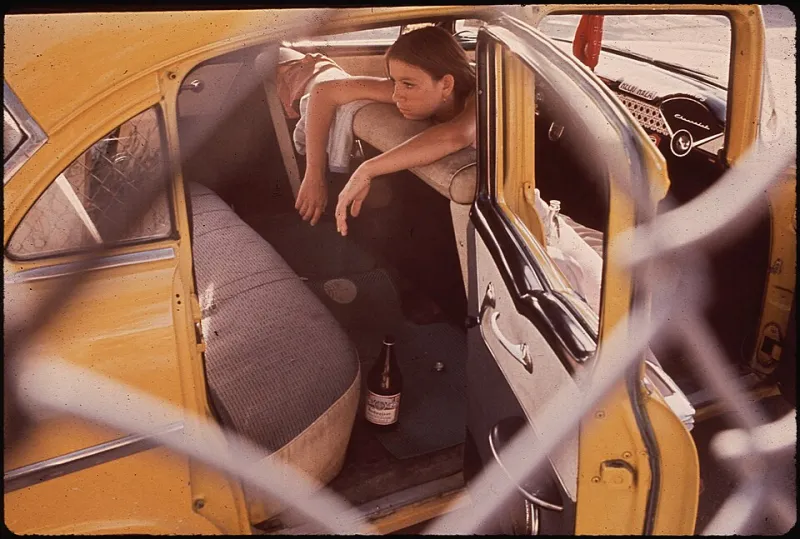
Photo: Danny Lyon, Public domain, via Wikimedia Commons
Let me paint you a picture. It's a Tuesday evening somewhere in suburban America. A 47-year-old parent — let's call her a GenX Daily reader, because she absolutely is — is sitting across the kitchen table from her 14-year-old, who is explaining, with the patient condescension only a teenager can deploy, that Instagram Reels and TikTok are "basically the same thing but completely different." The parent nods slowly. She grew up watching Degrassi on a 13-inch television set with rabbit ears. She once navigated an entirely new city using a folded paper map she bought at a gas station. She is not stupid.
But she is, in this moment, completely lost.
"I'm not a tech idiot," insists Derek Fontaine, 51, a high school history teacher and father of two from Portland, Oregon. "I built my own computer from parts in 1994. I was on AOL before most people knew what the internet was. But my 16-year-old showed me her finsta last week and I had to pretend I knew what that meant for a solid four minutes before I could Google it in the bathroom."
This is Gen X parenting in 2025: a daily exercise in humility, improvisation, and the creeping suspicion that the rules changed while we were busy figuring out streaming bundles.
We Were Raised by Benign Neglect. We're Raising Kids in a Surveillance State.
The foundational Gen X childhood experience — and we don't say this with bitterness, we say it with genuine nostalgia — was freedom. Radical, unstructured, occasionally dangerous freedom. You left the house after breakfast, came home when the streetlights clicked on, and nobody tracked your location via GPS. Your parents didn't know where you were. Your parents didn't need to know where you were. You were fine. Mostly.
That experience — roaming the neighborhood on a Huffy, knocking on doors, making decisions without adult supervision, getting into low-stakes trouble and learning from it — shaped a generation that is deeply, philosophically committed to the idea that kids need space to figure things out.
And then we had children who exist, from birth, inside a networked world that documents everything, remembers everything, and never, ever lets anything go.
"I want my kids to have independence," says Janelle Okafor, 46, a marketing consultant and mother of three in Atlanta. "I really do. But independence in my childhood meant riding my bike to the 7-Eleven. Independence for my 12-year-old means being on Discord with forty strangers. Those are not the same risk profile."
She's not wrong. And therein lies the central tension of Gen X parenting: we have the instinct to let go, but we're letting go into an environment that our own childhood gave us exactly zero tools to evaluate.
The Skeptic's Advantage (And Its Limits)
Here's where Gen X actually has a genuine edge over every other parenting demographic, and we should own this without apology: we are constitutionally suspicious of things that seem too good or too easy. It's basically our factory setting.
We watched the music industry promise us CD quality would last forever. We watched dot-com millionaires evaporate. We watched MySpace, the platform our older Millennial cousins swore was the future of human connection, become a ghost town. We have watched enough enthusiastically-hyped technologies fail, pivot, monetize, and collapse to maintain a healthy baseline skepticism about any platform promising to revolutionize how people connect.
That skepticism is genuinely useful when talking to kids about social media. Gen X parents aren't dismissing TikTok because they don't understand it. They're questioning it because they've seen this movie before, and they know how the third act usually goes.
"I tell my kids that every platform is designed to keep them on it as long as possible, and that's not an accident — it's the business model," says Fontaine. "They roll their eyes, but I can see the wheels turning. That's what I want. I want them to look at a screen and ask who benefits from me looking at this right now? That's not a Gen Z question. That's a Gen X question."
Dr. Alicia Torres, a child psychologist based in Chicago who works extensively with families navigating tech boundaries, says this instinct has real value. "Gen X parents tend to ask better questions than they give themselves credit for. They're less likely to either completely ban technology or completely surrender to it. The ones I work with are usually trying to find a middle path, which is actually the right instinct."
The limit, Torres notes, is when skepticism tips into paralysis — or worse, into the kind of tech-shaming that makes kids hide their digital lives entirely.
Being the Cool Parent Who Questions Everything Is an Exhausting Full-Time Job
Every Gen X parent has a version of this fantasy: you're the parent who gets it. You're not the clueless boomer who thinks Facebook is the internet. You know what a meme is. You've watched at least two episodes of a show your kid likes without being asked. You are relatable.
And then your kid asks if they can have BeReal and you spend forty-five minutes reading privacy policy documents at 11pm while eating leftover pasta and questioning every decision you've ever made.
"The exhausting part isn't the technology," says Okafor. "It's the pace. Every six months there's a new platform, a new app, a new thing I need to understand well enough to have an informed opinion about. I'm not unwilling to do the work. I'm just tired. I have a job. I have a commute. I cannot also be a full-time digital anthropologist."
This is the part that doesn't get talked about enough in the breathless think-pieces about screen time and parental controls: the sheer bandwidth required to stay even marginally current is enormous, and Gen X is doing it while also managing careers, aging parents, and the general ambient chaos of midlife.
What We Actually Get Right
Here's the thing, though. For all the hand-wringing and bathroom Googling and finsta confusion, Gen X parents are doing something genuinely important that gets lost in the noise: they're modeling ambivalence.
Not indifference. Ambivalence. The real kind — the kind that acknowledges complexity, holds two competing ideas at once, and refuses to collapse into either techno-panic or techno-worship.
Our kids are watching us use technology while also complaining about it. They're watching us set the phone down at dinner while also immediately picking it back up. They're watching us be imperfect and human and contradictory, which is, it turns out, exactly what kids need to see.
"I don't think my kids are going to look back and say I had all the answers," Fontaine admits. "But I hope they look back and say I asked good questions. That I taught them to be critical. That I didn't just hand them a device and walk away."
That's not a bad legacy for a generation that grew up questioning everything from Reagan to New Coke to the designated hitter rule.
We're figuring it out. One awkward conversation about Discord at a time.
And yes, we still check voicemail. Old habits.
